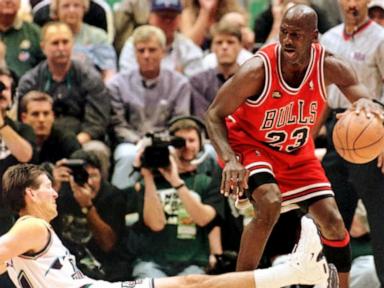
Some items transcend sports and enter the realm of cultural artifacts. A Chicago Bulls road jersey worn by Michael Jordan during Game 2 of the 1998 NBA Finals just fetched a staggering $14 million in a private treaty sale facilitated by Hunt Auctions. Purchased by real estate investor Ron Firman, the red jersey joins an elite class of collectibles that command prices usually reserved for museum-grade fine art.
If you follow the memorabilia market, you know the 1998 postseason holds legendary status. It was Jordan's final championship run with the Chicago Bulls, immortalized by the hit documentary The Last Dance. When a piece of fabric tied directly to that specific era changes hands for eight figures, it forces you to look at how sports history is valued today.
The Anatomy of a Record-Breaking Sale
The numbers behind this transaction are massive. The authenticated, game-worn, and autographed jersey was worn when the Bulls beat the Utah Jazz 93-88 in Salt Lake City on June 5, 1998, evening that championship series at one game apiece. Chicago eventually closed out the series in six games, capping off their second three-peat of the decade.
Prior to this private sale, the garment had changed hands only once since 2003. It carries rigorous authentication from MeiGray and SIA Authentication, alongside a signature verified by Upper Deck. That paper trail matters immensely at this price tier. High-end buyers won't drop millions without ironclad proof of provenance.
David Hunt, president of Hunt Auctions, pointed out that top-tier sports artifacts now rival traditional masterpieces.
"Michael Jordan and Babe Ruth stand above all others in the history of American sports," Hunt noted. "The record-setting price achieved for the related Michael Jordan jersey is yet another corroborative result as to the significance of Jordan within the industry and popular culture."
Where It Ranks in Sports History
While $14 million shatters previous benchmarks for basketball memorabilia, it sits just behind the ultimate throne of sports collectibles. The overall record for any game-worn jersey belongs to a Babe Ruth artifact from the 1932 World Series, which commanded an astonishing $24.12 million in 2024.
Even so, Jordan items from the 1998 Finals command a market of their own. A Game 1 jersey from that same series pulled in $10.1 million back in 2022, and another worn in Game 3 fetched $12.3 million at auction. Every piece from that specific postseason acts like a blue-chip stock, steadily climbing as wealthy collectors vie for fractional ownership of sports history.
买家 Ron Firman put it simply after the deal closed: "Michael Jordan was an incredibly talented player who is admired around the world. I'm very excited about the purchase."
Why the Market Keeps Exploding
Ten years ago, dropping eight figures on a sweaty basketball jersey sounded absurd. Today, it is just how modern high-net-worth wealth interacts with nostalgia. Traditional investments fluctuate, but cultural touchstones tied to undisputed icons like Jordan retain a psychological floor. People don't just buy a jersey; they buy a physical anchor to a golden era of competition.
Authentication technology has also evolved. Multi-point photo-matching means experts can align high-definition archival video frame-by-frame with tiny thread patterns and stitching anomalies on the jersey. When uncertainty drops to zero, big money follows.
The market for elite sports memorabilia isn't slowing down. As long as historical artifacts tied to the greatest competitors on earth remain finite, prices will continue to test new ceilings.