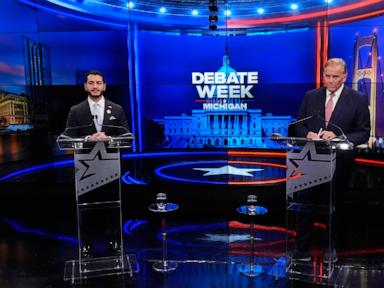
Elections in battleground states are messy, but the current Michigan Senate race has completely redrawn political lines. If you look at the contest between Democratic nominee Abdul El-Sayed and Republican nominee Mike Rogers, you aren't just seeing a standard party battle. You are watching a high-stakes collision where foreign policy, local faith communities, and tens of millions of outside dollars collide.
Voters in Michigan are exhausted. Jewish and Muslim communities, already reeling from the devastating toll of the war in Gaza, find themselves trapped in a political crossfire. The pressure doesn't just come from local stump speeches. It's fueled by historic spending from political action committees, fierce media scrutiny, and deep ideological rifts that are fracturing long-standing friendships and political alliances across the state.
The Record-Breaking Spending War No One Can Escape
Money changes everything in politics. In Michigan's primary cycle, the American Israel Public Affairs Committee (AIPAC) and its affiliated super PAC, United Democracy Project, poured historic sums into trying to defeat El-Sayed, who would become the first Muslim U.S. senator if elected. While AIPAC spent massive amounts opposing him—targeting voters with direct mailers and broadcast ads—the spending didn't stop when the primary ended.
Now, in the general election matchup against Rogers, outside groups are back at it. For the average voter sitting at home watching evening television or checking the mail, the onslaught of advertisements can feel relentless and disorienting.
Many voters point out the paradox of how these outside expenditures operate. Major pro-Israel funding groups often avoid mentioning Israel directly in their mass-market television ads. Instead, they pivot to economic talking points, manufacturing, or local jobs.
This strategy leaves voters questioning who is actually funding the messages hitting their screens. When you have millions of dollars trying to shape public opinion from behind a veil of opaque political messaging, trust takes a massive hit.
How the War in Gaza Reaches Local Neighborhoods
It's impossible to talk about this election without addressing the elephant in the room: the war in Gaza and its ripple effects across Michigan's unique demographic landscape. Michigan is home to the nation's largest Arab American community, alongside a vibrant and deeply concerned Jewish population of roughly 130,000 residents.
For these communities, foreign policy isn't an abstract debate happening thousands of miles away. It hits close to home.
- Jewish voters are heavily processing anxieties regarding rising antisemitism, safety concerns, and rhetoric surrounding Israel’s right to exist. Recent security threats and local incidents, including a high-profile attack on a West Bloomfield synagogue earlier this year, have left many community members feeling deeply vulnerable.
- Muslim and Arab American voters are dealing with their own distinct forms of anxiety, including intense media scrutiny over candidate backgrounds, policy positions on foreign aid, and worries about civil liberties.
When candidates take hardline stances or stumble over sensitive local incidents—such as El-Sayed's controversial remarks earlier this year regarding a synagogue attack, for which he later apologized—the trust deficit widens. Some Jewish Democrats have broken ranks entirely, choosing to look toward Republican alternative options or withholding support, while progressive factions double down on pushing for structural shifts in U.S. foreign policy.
Friendships and Coalitions Fracturing Under Pressure
The toxicity of the race has trickled down into everyday social circles. Close friends who spent decades volunteering together for local democratic causes are now drawing hard boundaries.
In Oakland County and across the Detroit suburbs, it's become common for long-time allies to explicitly ban political talk at social gatherings. When political survival and identity feel tied to a ballot, compromises are hard to find.
On one side, progressive activists argue that questioning foreign lobbying and military aid is a necessary part of reforming American foreign policy. On the other side, moderate and conservative groups argue that rhetoric coming from the left crosses lines that threaten the security of minority groups at home.
Republicans, meanwhile, are aggressively stepping into this vacuum. The Republican Jewish Coalition and figures like Texas Senator Ted Cruz have actively courted Jewish voters who feel abandoned or alienated by the fractures within the Democratic party.
What Comes Next for Michigan Voters
If you are trying to make sense of your ballot this November, the reality is stark. This race isn't going to be decided by quiet consensus. It's going to come down to turnout, momentum, and whether voters can see past the multi-million-dollar ad campaigns trying to dictate their choices.
Don't expect the noise to quiet down before election day. Take a hard look at the actual platforms, ignore the anonymous mailers flooding your mailbox, and focus on local accountability rather than external noise.



