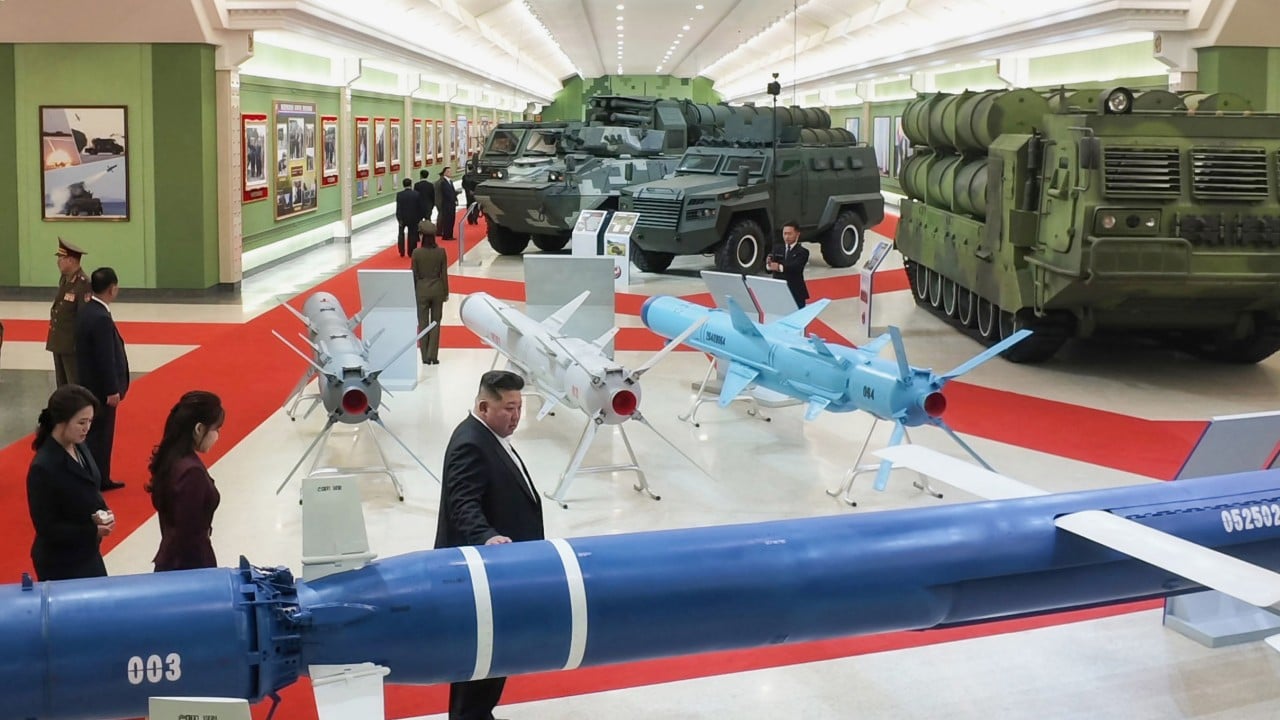
North Korea doesn't do things by halves. When Pyongyang decides to show off its military hardware, it doesn't just hold a standard military parade down Kim Il-sung Square. Instead, it builds a permanent temple.
The newly inaugurated National Defense Revolution Museum opened its doors to mark the 81st founding anniversary of the Workers' Party of Korea. Walking through its tunnels and galleries feels less like visiting a standard historical archive and more like touring an industrial showroom of doom. You see everything from personal combat gear and small arms up to massive intercontinental ballistic missiles.
If you want to understand how the regime views its survival, you have to look at what's inside these exhibition halls. It's a calculated mix of ideological theater and hard military signaling.
Inside the Hall of Strategic Power
State media images released by the Korean Central News Agency show galleries designed to look like underground concrete tunnels. Lined up shoulder-to-shoulder are the crown jewels of North Korea's strategic rocket forces.
The crown jewel of the exhibit is the Hwasong-20, an intercontinental ballistic missile that Pyongyang presents as fully capable of striking the United States mainland. Next to it stand older heavyweights like the liquid-fueled Hwasong-17, alongside the hypersonic Hwasong-16Ma and submarine-launched ballistic missiles.
It isn't just about ICBMs, though. The museum layout gives equal floor space to tactical innovations that have evolved rapidly over recent years. You'll find submarine-launched weapons, naval anti-ship missiles like the Badasuri, large combat and reconnaissance drones, small suicide drones, cruise missiles, and 600-millimeter super-large multiple rocket launchers.
Why display all of this now? Timing is everything in North Korean politics.
The Message Behind the Exhibition
Leader Kim Jong-un inspected the museum alongside top military brass, his wife, and his daughter, Kim Ju-ae. In his opening remarks, Kim didn't mince words. He called the facility a national treasure that intuitively shows how the safety and dignity of the nation are safeguarded.
By putting these weapon systems on permanent display, Pyongyang is achieving two distinct goals.
First, it feeds domestic propaganda. Generations of North Koreans grow up under constant warnings of external threats. A physical monument filled with advanced rocketry reinforces the narrative that state militarization is the only shield protecting the population.
Second, it sends an unmistakable outward message. As regional diplomacy shifts and foreign capitals debate potential summits or policy changes, Pyongyang wants every foreign intelligence agency to see its industrial output up close. The message is blunt: sanctions haven't stopped the assembly lines.
Beyond the Museum Walls
This museum opening doesn't exist in a vacuum. Just days after the ribbon-cutting ceremony, state outlets announced successful ballistic missile tests incorporating artificial intelligence technology.
The regime is aggressively modernizing. What started decades ago as a conventional artillery-heavy force has transformed into a nuclear-armed state with diverse delivery systems. Whether these weapons perform as advertised in a real conflict remains an open question among international defense analysts, but the industrial capacity to build and display them is real.
The museum stands as a permanent fixture of North Korea's strategic identity. It merges historical grievance with modern high-tech weaponry, ensuring that the country's defense apparatus remains front and center in daily political life.



