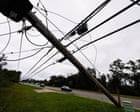
Darkness fell across the Florida Panhandle and southern Alabama long before the wind actually stopped howling. Nearly 396,000 homes and businesses sat without power early Sunday morning, trapped in the immediate aftermath of Hurricane Isaias. When a storm slams ashore as a category 2 monster near tourist hotspots like Destin, the postcard views vanish instantly. You're left with snapped utility poles, shredded roofs, and the grim reality of emergency grid failures.
Isaias roared into the Gulf Coast on Friday, packing hurricane-force winds that ripped the roof straight off a Pensacola hotel and flattened buildings in Panama City Beach. But storms don't just wreck coastal architecture. They punch holes straight through the infrastructure we take for granted every single day. If you live anywhere near the Gulf, you know the drill. You prep your hurricane kit, you fill your gas cans, and you wait. Yet, no matter how much you prepare, the quiet hum of a neighborhood losing power is always jarring.
The Human Toll Behind the Outages
Infrastructure repairs take time, but human lives cannot be replaced. At least four deaths have already been tied directly to Isaias.
In Escambia County, Florida, a woman died tragically when a tree crashed through her home. In that same county, another life was lost to a silent killer that claims far too many victims post-storm: carbon monoxide. A man died from fumes generated by a portable gas generator running inside his garage. Four family members—ranging from a four-year-old child to a 72-year-old adult—barely survived the same poisoning and required emergency medical treatment. Additional reporting by USA.gov delves into comparable views on this issue.
Over in Alabama, the story repeated itself. Birmingham fire officials confirmed a fatality after a massive tree fell onto a residence. Another person lost their life in Barbour County during a motor vehicle crash caused by a downed tree blocking a dark roadway.
These aren't just statistics on a news ticker. They highlight the hidden dangers that lurk long after the eye of a hurricane passes overhead.
Why Generator Safety Gets Overlooked
Every single hurricane season, emergency management teams scream from the rooftops about generator safety. And every single year, people ignore the warnings because they're desperate for AC or refrigeration after losing power.
Generators produce deadly carbon monoxide gas. You can't see it, you can't smell it, and it will knock you unconscious in minutes. Putting a generator inside a garage, even with the door cracked, is basically playing Russian roulette with your family's safety.
If you're running a backup generator during a grid failure, follow these hard rules:
- Keep it at least twenty feet away from your house.
- Point the exhaust away from all doors, windows, and vents.
- Install working carbon monoxide detectors with fresh batteries inside your living space before you ever fire the engine up.
The Broader Path of Destruction
While Florida absorbed the initial punch, Isaias pushed inland as a post-tropical cyclone, tracking north with a massive footprint of heavy rain and tropical-force winds. Alabama's Gulf Coast felt the brunt in cities like Mobile, where emergency crews scrambled to clear blocked roads tangled in live wires.
Federal response mechanisms kicked into gear quickly. President Donald Trump approved emergency declarations for Florida, Alabama, and Georgia, unlocking federal aid to speed up recovery efforts. Furthermore, the US Energy Department authorized emergency crude oil exchanges from the strategic petroleum reserve to stabilize supply chains jittery from storm disruptions.
The threat didn't stop at state lines. National Weather Service forecasters warned that the system's remnants would drench the central Appalachians and mid-Atlantic. Flash flooding remains a very real danger in parts of Georgia and the Carolinas. Meanwhile, out in the Pacific, an entirely separate atmospheric monster named Simon flirted with category 5 strength near Mexico, proving that coastal communities face relentless pressure from extreme weather cycles.
Getting power back online across the Southeast will take days, sometimes weeks for the hardest-hit rural pockets. Crews from neighboring states are already rolling in trucks, working around the clock in sweltering heat and standing water.
Check on your neighbors. Keep your generators outside. And respect the power of a storm that changes landscape geography overnight.



