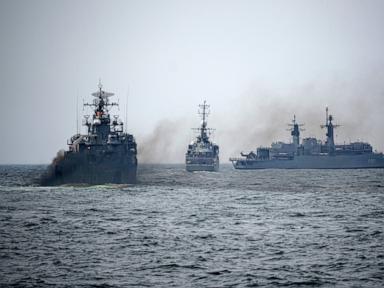
The war doesn't stay neatly contained inside Ukrainian borders. Anyone paying attention knows this, but recent events on the water prove it in terrifying fashion. Drone strikes in the Black Sea are escalating rapidly, and they are pushing military alliances closer to a direct clash than most people realize.
When unmanned aerial and naval systems target shipping lanes, energy infrastructure, or military vessels near NATO member states like Romania and Turkey, the margin for error drops to zero. A single miscalculated trajectory or an errant interception puts the entire alliance on edge. Let's look at why these maritime attacks change the calculus of the conflict and what it means for global security.
The Geography of Risk in the Black Sea
The Black Sea is a crowded, high-stakes theater. It borders Ukraine, Russia, Turkey, Romania, Bulgaria, and Georgia. Because Turkey controls the maritime entry points via the Bosporus and Dardanelles straits under the Montreux Convention, military movements are heavily restricted, forcing a reliance on air and missile power.
When drone strikes occur close to NATO maritime boundaries, the response window shrinks. Air defense batteries on the Romanian coast track targets that move at high speeds over international waters. If a stray projectile crosses a land border or hits a commercial cargo vessel flying a foreign flag, the legal and political triggers for mutual defense treaties start flashing red.
Governments in Bucharest and Ankara aren't panicking, but they are altering their posture. Air patrols have intensified. Intelligence-sharing aircraft circle international airspace daily to monitor every launch signature. The water has become a testing ground where Moscow evaluates how far it can push military operations without triggering a unified military retaliation.
Testing Article 5 Without Crossing the Line
Moscow plays a deliberate game of strategic ambiguity. By deploying asymmetric warfare—like naval drones packed with explosives or loitering munitions—Russia tests the outer limits of NATO resolve.
The strategy is simple. If a drone hits a grain silo near the Danube River inside Romania, is that an act of war, or is it collateral damage from targeting Ukrainian export hubs? If debris falls on NATO territory, does it mandate a kinetic response? By keeping incidents below the threshold of a massive, undeniable invasion of an alliance member state, operations in the Black Sea create a gray zone.
Defense analysts point out that this is designed to fracture political consensus within the alliance. Not every capital in Europe views a localized maritime explosion with the same urgency as a direct missile strike on Warsaw or Berlin. Moscow counts on this hesitation. They want to see if the alliance will blink, issue sternly worded diplomatic condemnations, or actually mobilize forces to secure international shipping lanes.
Economic Chokepoints and Global Fallout
This isn't just about military strategy. The Black Sea is an economic lifeline. Before the full-scale invasion, millions of tons of wheat, corn, and barley flowed out of Ukrainian ports to feed nations across Africa, the Middle East, and parts of Europe.
Drone warfare makes commercial shipping radioactive for insurers. Lloyd's of London and other major marine insurers look at escalating attacks and immediately jack up premiums or refuse coverage entirely. Grain corridors shrink. Food prices spike globally.
When a commercial vessel gets caught in the crossfire or detained for inspection, it sends shockwaves through global supply chains. Nations that rely on affordable imports feel the pressure instantly. The strikes aren't just hitting military targets; they are weaponizing global hunger and economic stability to pressure Western capitals into reducing support for Kyiv.
What Comes Next for Regional Security
The escalation in the Black Sea will likely get worse before it stabilizes. Ukraine continues to build out domestic asymmetric naval capabilities, fielding surface drones that can strike targets hundreds of miles away from friendly bases. Russia responds by hardening naval base defenses in Novorossiysk and increasing air patrols over the western basin.
For NATO, the challenge is maintaining deterrence without escalating into a hot war. Enhanced surveillance, increased naval presence under national flags rather than direct alliance missions, and robust electronic warfare jamming are the tools being deployed right now.
If you want to track where this conflict is heading, stop looking solely at the frontlines in the Donbas. Keep your eyes on the water. The Black Sea is where the rules of modern maritime conflict are being written—and it's where a single accident could change the world overnight.



